By Billy Janse van Rensburg — Invicta Property Development · Published 2026-07-14 · Updated 2026-10-01
Section 13sex lets a landlord write off 5% of the cost of new residential units every year for 20 years — but only once you own five of them, and almost nobody buying their first rental has heard of it. I sell exactly the kind of new units this section rewards, so check everything I say with your own tax practitioner. What follows is the plain-language version: the five conditions SARS applies, the 55% rule on developer purchases, a worked example on five real townhouses, and the clawback when you sell. Before we start, plainly: this is not tax advice, and a registered tax practitioner must confirm your position before you structure anything.
The allowance in one paragraph
Here is the whole mechanism in one breath. If you own at least five new and unused residential units in South Africa and let all of them out as a trade, section 13sex of the Income Tax Act lets you deduct 5% of each unit's qualifying cost from your taxable income every year, on a straight line, for 20 years. Run the full course and the section hands the entire qualifying cost back over two decades. The authority document is SARS Interpretation Note 106, which is where your practitioner will go to verify anything I say below.
The section is well documented already: TaxTim covers it, several law firms publish solid summaries, and Interpretation Note 106 itself is thorough. None of them runs scenario numbers on units you can actually buy, which is the gap this post fills. The Act also carries an enhanced allowance for low-cost residential units; the townhouses in my example sit above the low-cost definition, so I mention that rate only so you know it exists.
The five conditions SARS actually checks
The section reads like tax law, but the tests fit on one hand.
One: you own at least five residential units. Two: every unit is new and unused when you acquire it; resale stock never qualifies, however recent, which is why buying off-plan or brand new from a developer is the standard route in. Three: all five are in South Africa. Four: all five are used in your trade, which for an ordinary landlord means genuinely let to tenants. Five: you do not live in any of them; occupy a unit yourself, even partly, and that unit falls out of your count.
The count is the gate, and it is what catches people. Buy unit one this year and units two to four over the next three years, and your tax return sees nothing from 13sex. Four units earn no allowance at all. The allowance switches on for all five only once the fifth qualifying unit is owned and let. Sequencing matters, so plan the count before the first purchase rather than discovering the gate at unit three.
The 55% rule when you buy from a developer
Qualifying cost is not simply what you paid, and this is the detail most people get wrong in their own favour. Build a unit yourself and your qualifying cost is the actual cost of erecting it. Buy a completed, new and unused unit from a developer, as you would here, and the Act deems 55% of the purchase price to be the qualifying cost; buy an improvement and the deemed figure is 30%. The apportionment exists because a developer's price includes land and margin, while the allowance is aimed at the building itself.
On one of our entry plans at R1,249,000, the arithmetic runs like this: 55% of the price gives a deemed qualifying cost of R686,950, and 5% of that figure comes off your taxable income every year for 20 years. One helpful wrinkle on a new build: because the price is all-inclusive, with transfer duty, bond registration and legal fees carried by the developer, the R1,249,000 is genuinely the whole number you paid. On resale stock those extras sit on top, and the costs of buying a house guide itemises them line by line.
A worked example on five real townhouses
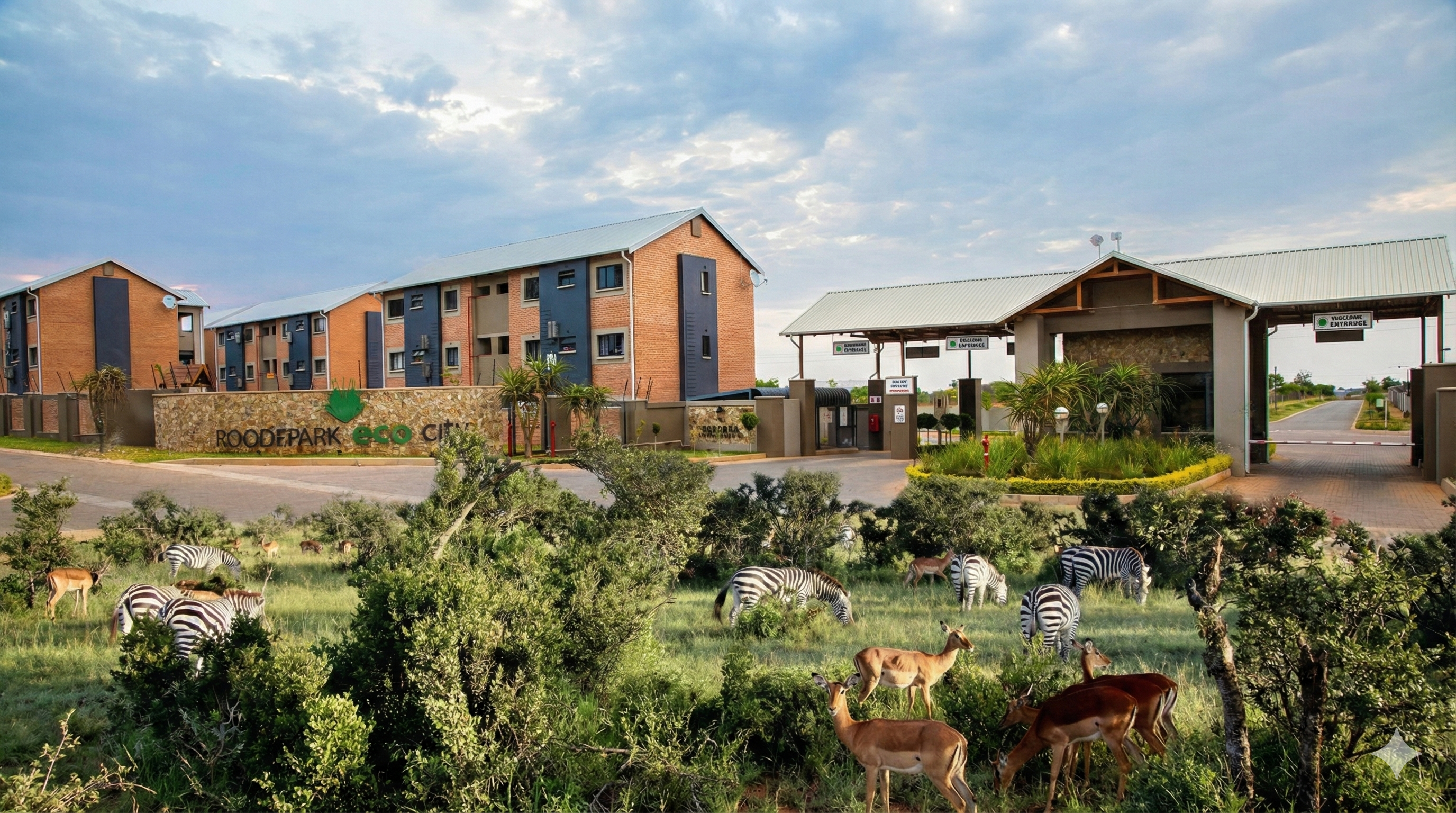
Take five of our entry plans at Roodepark Eco City 2, the final phase of the wildlife-estate development we are building in Montana, Pretoria. Five at R1,249,000 each is R6,245,000. The deemed qualifying cost is 55% of that, R3,434,750, and the annual allowance is 5% of the deemed cost: R171,738 a year, every year, for 20 years. At a 27% marginal rate that allowance is worth R46,369 a year in tax you do not pay.
From there the engine runs two versions of the same deal. The assumptions, stated in full: rent of R10,900 a month per unit escalating at 7% a year, costs inflating at 5%, property growth at 4%, a 27% marginal rate, a levy of R1,425 and rates of R875 per unit, and bond interest at 10.75%, which is unconfirmed and subject to your bank's quote.
Bought cash, the model shows tax saved of roughly R463,691 by year 10, a net rental surplus of R32,469 a month across the five units in year one, and wealth created of R8,330,231 by year 10, 1.33 times the capital in.
Bought on bond, with 20% deposits of R249,800 per unit and an instalment of R10,144 per unit per month, the interest deduction stacks on top of the allowance: tax saved by year 10 rises to R1,762,583, the year-one top-up is R6,249 a month across the portfolio, and wealth created by year 10 is R4,818,413, which is 3.86 times the R1,249,000 of deposits invested.
Section 24J and section 20A: the cousins people confuse it with
Two neighbouring sections shape the numbers above, and people regularly blur all three together.
Section 24J is the reason the bond scenario beats the cash scenario on tax. Interest on a bond over a rental property is deductible against the rental income, and in the early years of a 20-year bond the interest portion of each instalment is large. That deduction stacks on top of the 13sex allowance, which is why the bond route above shows nearly four times the ten-year tax saving of the cash route. Bigger early deductions, honestly accounted, are the whole story of gearing's higher multiple.
Section 20A is the cousin people forget, and it bites the other way. If you sit in the top tax bracket, SARS may ring-fence your rental losses: instead of a loss reducing the tax on your salary, it is carried forward and can only be set off against future rental income. Any plan that quietly assumes every loss lands against salary needs a hard look at 20A, and it is exactly the sort of thing a practitioner should test before you sign.
The catch when you sell: recoupment
Now the part the glossy versions skip. Section 13sex is a deferral and a cash-flow tool, not a permanent gift. Every rand you deduct lowers the unit's tax value. When you eventually sell, section 8(4)(a) can claw those prior deductions back into your income if the proceeds exceed that tax value — and on a property that has grown for a decade, they usually will.
Said plainly: expect to repay some or all of the deductions in the year you sell. What the section really buys you is time and cash flow. You take the deductions now, while you are paying bonds and carrying tenants, and you settle the recoupment out of sale proceeds later, in a year of your choosing. That trade is often still a very good one; it is also a trade, and anyone presenting the allowance as free money is leaving this paragraph out. Model the exit year with your practitioner before you commit to the entry.
Paperwork that survives an audit
SARS grants nothing on trust, and this claim runs per unit, per year, for two decades, so the file matters. Keep the sale agreement for each unit proving it was new and unused and bought from the developer, with the transfer date. Keep every signed lease, because the trade requirement means showing all five units genuinely let. Keep a one-page schedule per unit: purchase price, the 55% deemed cost, the 5% claimed each year, and the running tax value, so the recoupment maths is ready the day you sell. Note the date the fifth unit was first let, because that is the day the whole claim switches on.
And the second, final version of the warning I opened with: this is not tax advice, and a registered tax practitioner must confirm your position before you structure anything. Model the 5-unit scenario against a single unit on the live calculator, print the result, and take it to a registered tax practitioner — that one meeting is the cheapest step in the whole strategy.
Invicta Roodepark Eco City 2 blog: Section 13sex in plain language: the 5-unit rule, what you can write off, and what SARS actually requires. Section 13sex lets a landlord write off 5% of the cost of new residential units every year for 20 years — but only once you own five of them, and almost nobody buying their first rental has heard of it. I sell exactly the kind of new units this section rewards, so check everything I say with your own tax practitioner. What follows is the plain-language version: the five conditions SARS applies, the 55% rule on developer purchases, a worked example on five real townhouses, and the clawback when you sell. Before we start, plainly: this is not tax advice, and a registered tax practitioner must confirm your position before you structure anything. The allowance in one paragraph: Here is the whole mechanism in one breath. If you own at least five new and unused residential units in South Africa and let all of them out as a trade, section 13sex of the Income Tax Act lets you deduct 5% of each unit's qualifying cost from your taxable income every year, on a straight line, for 20 years. Run the full course and the section hands the entire qualifying cost back over two decades. The authority document is SARS Interpretation Note 106, which is where your practitioner will go to verify anything I say below.
The section is well documented already: TaxTim covers it, several law firms publish solid summaries, and Interpretation Note 106 itself is thorough. None of them runs scenario numbers on units you can actually buy, which is the gap this post fills. The Act also carries an enhanced allowance for low-cost residential units; the townhouses in my example sit above the low-cost definition, so I mention that rate only so you know it exists. The five conditions SARS actually checks: The section reads like tax law, but the tests fit on one hand.
One: you own at least five residential units. Two: every unit is new and unused when you acquire it; resale stock never qualifies, however recent, which is why buying off-plan or brand new from a developer is the standard route in. Three: all five are in South Africa. Four: all five are used in your trade, which for an ordinary landlord means genuinely let to tenants. Five: you do not live in any of them; occupy a unit yourself, even partly, and that unit falls out of your count.
The count is the gate, and it is what catches people. Buy unit one this year and units two to four over the next three years, and your tax return sees nothing from 13sex. Four units earn no allowance at all. The allowance switches on for all five only once the fifth qualifying unit is owned and let. Sequencing matters, so plan the count before the first purchase rather than discovering the gate at unit three. The 55% rule when you buy from a developer: Qualifying cost is not simply what you paid, and this is the detail most people get wrong in their own favour. Build a unit yourself and your qualifying cost is the actual cost of erecting it. Buy a completed, new and unused unit from a developer, as you would here, and the Act deems 55% of the purchase price to be the qualifying cost; buy an improvement and the deemed figure is 30%. The apportionment exists because a developer's price includes land and margin, while the allowance is aimed at the building itself.
On one of our entry plans at R1,249,000, the arithmetic runs like this: 55% of the price gives a deemed qualifying cost of R686,950, and 5% of that figure comes off your taxable income every year for 20 years. One helpful wrinkle on a new build: because the price is all-inclusive, with transfer duty, bond registration and legal fees carried by the developer, the R1,249,000 is genuinely the whole number you paid. On resale stock those extras sit on top, and the costs of buying a house guide itemises them line by line. A worked example on five real townhouses: Take five of our entry plans at Roodepark Eco City 2, the final phase of the wildlife-estate development we are building in Montana, Pretoria. Five at R1,249,000 each is R6,245,000. The deemed qualifying cost is 55% of that, R3,434,750, and the annual allowance is 5% of the deemed cost: R171,738 a year, every year, for 20 years. At a 27% marginal rate that allowance is worth R46,369 a year in tax you do not pay.
From there the engine runs two versions of the same deal. The assumptions, stated in full: rent of R10,900 a month per unit escalating at 7% a year, costs inflating at 5%, property growth at 4%, a 27% marginal rate, a levy of R1,425 and rates of R875 per unit, and bond interest at 10.75%, which is unconfirmed and subject to your bank's quote.
Bought cash, the model shows tax saved of roughly R463,691 by year 10, a net rental surplus of R32,469 a month across the five units in year one, and wealth created of R8,330,231 by year 10, 1.33 times the capital in.
Bought on bond, with 20% deposits of R249,800 per unit and an instalment of R10,144 per unit per month, the interest deduction stacks on top of the allowance: tax saved by year 10 rises to R1,762,583, the year-one top-up is R6,249 a month across the portfolio, and wealth created by year 10 is R4,818,413, which is 3.86 times the R1,249,000 of deposits invested.
Every figure is a model output on the stated assumptions, not a promise. Do not quote mine: model the 5-unit scenario live on the property investment calculator with your own rent and rate and watch what moves. Section 24J and section 20A: the cousins people confuse it with: Two neighbouring sections shape the numbers above, and people regularly blur all three together.
Section 24J is the reason the bond scenario beats the cash scenario on tax. Interest on a bond over a rental property is deductible against the rental income, and in the early years of a 20-year bond the interest portion of each instalment is large. That deduction stacks on top of the 13sex allowance, which is why the bond route above shows nearly four times the ten-year tax saving of the cash route. Bigger early deductions, honestly accounted, are the whole story of gearing's higher multiple.
Section 20A is the cousin people forget, and it bites the other way. If you sit in the top tax bracket, SARS may ring-fence your rental losses: instead of a loss reducing the tax on your salary, it is carried forward and can only be set off against future rental income. Any plan that quietly assumes every loss lands against salary needs a hard look at 20A, and it is exactly the sort of thing a practitioner should test before you sign. The catch when you sell: recoupment: Now the part the glossy versions skip. Section 13sex is a deferral and a cash-flow tool, not a permanent gift. Every rand you deduct lowers the unit's tax value. When you eventually sell, section 8(4)(a) can claw those prior deductions back into your income if the proceeds exceed that tax value — and on a property that has grown for a decade, they usually will.
Said plainly: expect to repay some or all of the deductions in the year you sell. What the section really buys you is time and cash flow. You take the deductions now, while you are paying bonds and carrying tenants, and you settle the recoupment out of sale proceeds later, in a year of your choosing. That trade is often still a very good one; it is also a trade, and anyone presenting the allowance as free money is leaving this paragraph out. Model the exit year with your practitioner before you commit to the entry. Paperwork that survives an audit: SARS grants nothing on trust, and this claim runs per unit, per year, for two decades, so the file matters. Keep the sale agreement for each unit proving it was new and unused and bought from the developer, with the transfer date. Keep every signed lease, because the trade requirement means showing all five units genuinely let. Keep a one-page schedule per unit: purchase price, the 55% deemed cost, the 5% claimed each year, and the running tax value, so the recoupment maths is ready the day you sell. Note the date the fifth unit was first let, because that is the day the whole claim switches on.
And the second, final version of the warning I opened with: this is not tax advice, and a registered tax practitioner must confirm your position before you structure anything. Model the 5-unit scenario against a single unit on the live calculator, print the result, and take it to a registered tax practitioner — that one meeting is the cheapest step in the whole strategy. Homes from R1 249 000 all-inclusive, no transfer duty. Contact: 063 600 3905. Official site: https://www.invictaproperties.co.za/.